%20(1).svg)

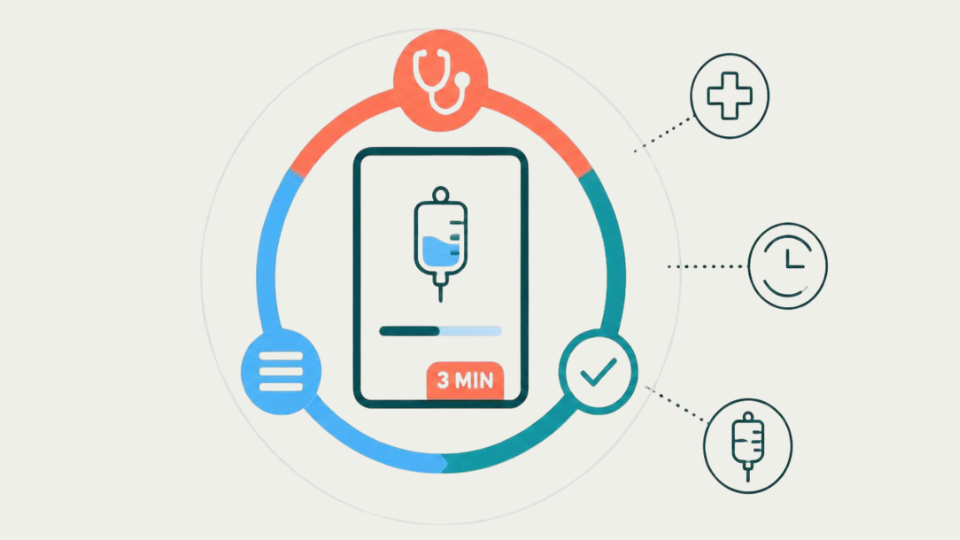
Microlearning is usually sold on convenience: shorter modules fit better into a clinical day. True, and incomplete. The convenience argument would predict that simply chopping a 45-minute module into nine five-minute segments produces a better outcome, and it mostly doesn't.
What the evidence actually supports is narrower and more interesting. It is not brevity that produces retention. It is distribution over time combined with active retrieval. Short format is what makes those two things practical in a clinical workforce — it is the enabling condition, not the mechanism.
Getting this distinction right matters, because programs that implement short-format passive content and expect retention gains are implementing the packaging without the active ingredient.
Section 1: What the research actually shows
Spacing. Distributing study across multiple sessions produces better long-term retention than concentrating the same total time into one session. This is among the most robustly replicated findings in learning science, dating to Ebbinghaus and confirmed repeatedly since.
Retrieval practice. Being required to produce an answer from memory strengthens retention more than re-reviewing the same material. Roediger and Karpicke's work on test-enhanced learning (Psychological Science, 2006) is the canonical demonstration.
In medical populations specifically. Kerfoot and colleagues randomized medical students to spaced education and found significantly improved retention of clinical knowledge (Medical Education, 2007). Follow-up work reported retention gains among urology residents persisting after two years. Systematic reviews of spaced, interleaved, and retrieval practice in medical training continue to support the approach, while noting variability in study quality.
On behavior, not just knowledge. The most operationally relevant study: a randomized cluster crossover trial delivered spaced education with retrieval practice via smartphone app to 354 clinicians in a learning health system. Clinicians receiving the intervention had roughly double the odds of intravenous fluid prescribing consistent with evidence-based standards.
And the limitation the authors themselves report: the improvement was not sustained at 8 to 12 weeks.
That finding deserves more prominence than it usually gets. It says the mechanism can move real clinical behavior, and that the effect decays without continued reinforcement. Any microlearning program designed as a one-time campaign is designed against the evidence.
Section 2: Designing three-to-five minute compliance modules
One concept per unit. If a unit contains two teachable points, it is two units. The discipline sounds trivial and is the single most common failure — organizations shorten runtime while keeping the same number of ideas, producing dense short content that is harder, not easier.
Lead with the situation. Open with the clinical circumstance in which the knowledge applies rather than with the regulatory framing. The learner needs to recognize relevance immediately; the regulation can be named after the scenario has established why it matters.
End with retrieval, not review. The closing interaction must require the learner to produce an answer. A summary slide is review, and review is the thing retrieval practice outperforms. This is where most short-format content quietly abandons the mechanism it claims to use.
Give feedback that explains. Correct-answer feedback should say why, briefly. A bare right/wrong marker forgoes most of the benefit.
Sequence with expanding intervals. Reinforcement at increasing gaps — days, then weeks, then months — reflects the spacing literature and directly addresses the non-durability finding above.
Decide what cannot be microlearned. Procedural skills requiring demonstration, competency assessments needing observation, and content requiring extended case reasoning are not candidates. A program claiming everything can be delivered in five-minute units is one that will eventually be caught doing it badly.
Section 3: Mobile and offline access
For shift-based and community-based staff the delivery channel is not a convenience feature; it determines whether the schedule above is achievable at all.
Offline capability. Connectivity varies by physical location inside a hospital and is entirely absent for community and home-care staff working in patients' homes. Content must download and completion records must sync when connectivity returns — and the records must retain the true completion timestamp, not the sync timestamp, or the audit trail misrepresents when the work happened.
Genuine mobile design. A desktop module rendered small is not mobile learning. Interactions must work by touch, text must be legible at arm's length, and units must be completable in a single uninterrupted sitting of a few minutes.
Interruption tolerance. Clinical work is interrupted by definition. State must be preserved so a learner returning after twenty minutes resumes rather than restarts. Losing progress once teaches the learner to defer to a protected block — which is exactly the behavior the format exists to eliminate.
Notification timing by shift. Reinforcement prompts delivered on a business-hours schedule systematically disadvantage night staff.
Section 4: Measuring the thing that matters
Completion rates rise almost automatically with short-format content. This makes them useless as a measure of whether the program worked, and dangerous as a reported metric, because the number improves while nothing else does.
Retrieval performance over time. Track accuracy on reinforcement questions at successive intervals. Improving accuracy at lengthening intervals is the signal that retention is occurring.
First-attempt accuracy on reinforcement. Distinguishes recall from re-learning within the session.
Decay curves by topic. Which content degrades fastest tells you where reinforcement intervals need shortening. This is the operational answer to the 8-to-12-week finding, and it is only visible if you are measuring at intervals rather than at completion.
Behavioral proxies where they exist. The Vanderbilt trial measured prescribing patterns, not test scores. Where a compliance topic has an observable behavioral correlate — hand hygiene audit results, incident reports, documentation-quality measures — that correlation is far stronger evidence than any completion figure. It is also harder to obtain, which is precisely why it is more credible.
Compliance evidence remains separate. Retention measurement is a program-quality question. Regulatory evidence remains a documentation question — under 45 CFR § 164.316, records of required training must be retained six years from creation or the date last in effect. Microlearning changes the delivery format; it does not change what must be documented, and fragmenting content across many units makes the record-keeping architecture more important rather than less.
The reframe
The reason to move compliance content to short units is not that clinicians have short attention spans. It is that the spacing and retrieval mechanisms that actually produce retention require distribution over time, and distribution over time is only feasible in a clinical workforce if each encounter is small enough to fit in the gaps that genuinely exist.
Short format is the delivery condition. Spacing and retrieval are the mechanism. Programs that adopt the first without the second get better completion rates and the same retention they had before — which is the outcome most likely to be mistaken for success.
CTA: Try a sample microlearning module built for clinical compliance — three minutes, one concept, retrieval-based.

.svg)
%20(1).svg)